

Determining whether a melanoma remains confined to the surface of the skin or has progressed to an invasive form can be one of the most challenging decisions clinicians face.
Thanks to funding support from the Australian Melanoma Research Foundation awarded in 2022 in honour of Warren Meanwell, researcher Dr Bruna Melhoranse Gouveia from Melanoma Institute Australia and The University of Sydney has spent the past several years tackling this challenge through her groundbreaking Lentigo Maligna Spectrum Project.
The project focused on lentigo maligna, the most common form of melanoma in situ in Australia. While lentigo maligna itself remains confined to the upper layers of the skin, some lesions progress to an invasive form known as lentigo maligna melanoma, which can require more extensive treatment and carries a greater risk to patients.
The question facing clinicians is a critical one: How can we accurately distinguish an early melanoma from one that has already become invasive?
“It is an honour to be awarded the Inaugural Warren Meanwell Melanoma Research Grant 2022. We hope our work will make a real difference that will ultimately improve outcomes for melanoma patients. Thank you.”
Distinguishing between early-stage and invasive disease is not always straightforward. Current diagnostic methods can struggle to identify the most concerning areas within larger lesions, making treatment decisions more complex.
Improving diagnostic accuracy has the potential to help clinicians determine when surgery is necessary, when less invasive treatments may be appropriate, and how best to manage each individual patient.
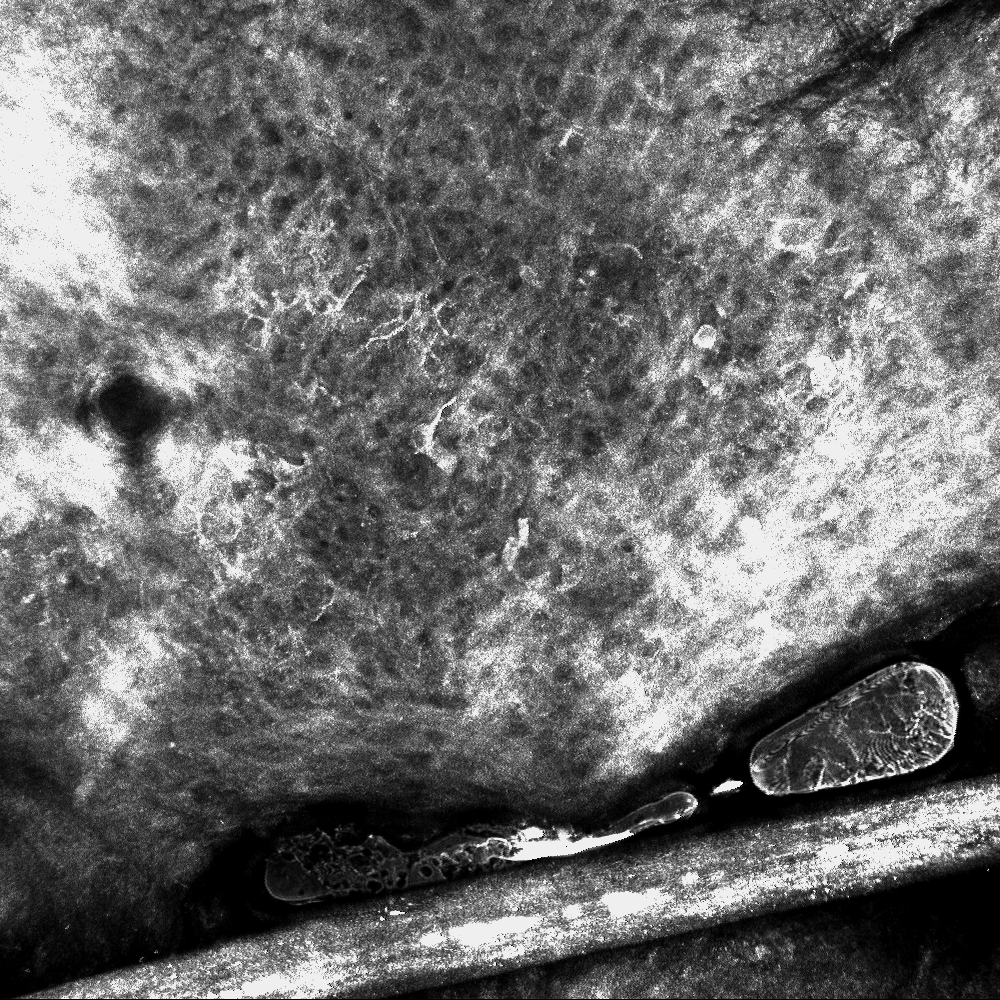
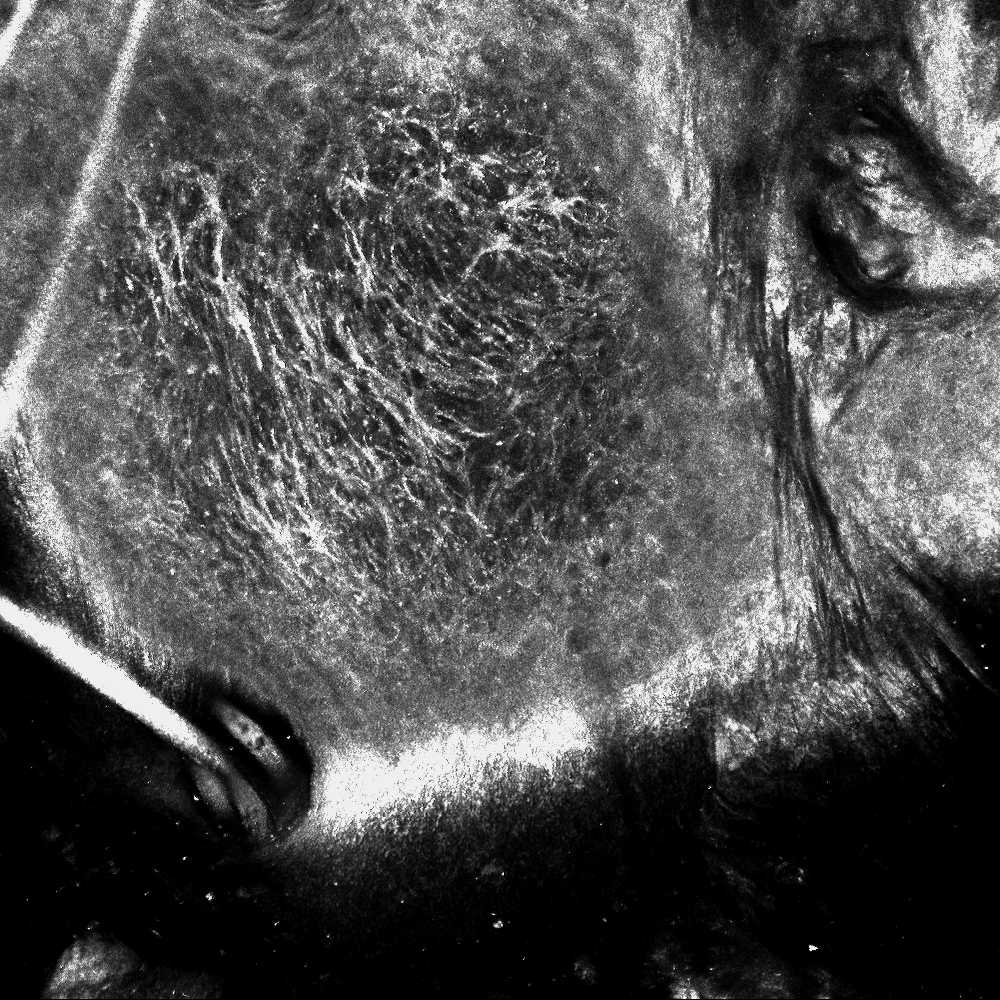
To address this challenge, Dr Gouveia’s research explored the use of Reflectance Confocal Microscopy (RCM), an advanced imaging technology that allows clinicians to examine skin cells in real time without the need for surgery.
Using this technology, the research team investigated how specific imaging features could be used to identify microscopic signs of melanoma invasion.
The findings demonstrated that RCM can help clinicians detect invasive components within lentigo maligna lesions more accurately and identify the most suspicious areas for biopsy.
This non-invasive approach has the potential to improve diagnostic confidence while helping ensure patients receive the most appropriate treatment.
A New Tool for Melanoma Diagnosis
One of the most significant outcomes of this project was the development of the Lentigo Maligna Spectrum Score: a new diagnostic scoring system designed to improve clinicians’ ability to distinguish between benign sun-damaged skin, early melanoma, and invasive melanoma.
The research showed that the tool significantly improved diagnostic accuracy, representing an important step toward more personalised and precise melanoma care.
By helping clinicians better understand where a lesion sits along the melanoma spectrum, the scoring system may support earlier diagnosis and more informed treatment decisions in the future.
While further research and validation are still required, the findings from this project have the potential to deliver earlier and more accurate diagnosis, improved detection of invasive melanoma and better targeted biopsies.
For patients, this could mean receiving the right treatment sooner while avoiding unnecessary interventions.
Building the Future of Melanoma Research
The project also highlights the importance of supporting emerging researchers who are dedicated to improving outcomes for people affected by melanoma.
Since receiving the inaugural Warren Meanwell Melanoma Research Grant in 2022, Dr Gouveia has continued to build on this work, contributing to ongoing advances in melanoma diagnosis and management.
Reflecting on the support she received, Dr Gouveia said:
“It is an honour to be awarded the Inaugural Warren Meanwell Melanoma Research Grant 2022. We hope our work will make a real difference that will ultimately improve outcomes for melanoma patients. Thank you.”
As melanoma rates continue to rise, research projects like the Lentigo Maligna Spectrum Project are helping bring us closer to a future where melanoma can be detected earlier, diagnosed more accurately, and treated more effectively.
Every breakthrough begins with research, and every research project begins with support from a community committed to changing the future of melanoma.
Australian Melanoma Research Foundation (AMRF) respects and is committed to protecting the privacy of the people whose personal information it collects. We collect personal information about individuals who are employed by us, our donors, our volunteers, other supporters, allied associations, consultants and service providers.
Whenever we collect personal information, we will identify ourselves as AMRF and ensure people are aware of why we are collecting information and how we plan to use it.
The type of personal information AMRF usually collects and holds includes names, addresses, telephone numbers, email addresses, donation date, reason for donation, merchandise orders and other information such as health related information pertaining to AMRF research and program delivery. This information may be collected in person, via our website on the secure payment gateway, as well as other sources.
When people visit our website, or download information from it, the following information is recorded by Google Analytics:
This information is only used for statistical and website development purposes. We make limited use of cookies on our website. We use cookies to improve the functionality of our website, and to remember user preferences when people return.
In the event where an individual shares unsolicited personal information that AMRF would not have collected for the purposes outlined above that information will be destroyed or de-identified as soon as is practicable.
We collect and use stakeholder’s personal information to carry out the functions and activities of AMRF and to comply with our legal obligations, to maintain and update our records and to help us manage and provide our services.
We may also use information to ask for support and to keep people informed about the ways in which our donors and supporters help us to make a difference to raise funds for research, awareness and early detection programs. People have the right to opt out of any communications from AMRF. This will not stop them receiving receipts and other transactional communications as required by law.
We may disclose personal information to third parties who assist us to perform functions on our behalf (such as commercial mail preparation services, this information is permanently deleted by the provider upon completion of the service and confirmed in writing of such). These external service providers are under a duty to maintain the privacy and security of your information in line with this Privacy Policy and to use your personal information only for the purpose for which it is disclosed.
AMRF does not use any government related identifiers, such as Medicare numbers or tax file numbers, of an individual as our own identifier.
We may use people’s information within AMRF only in connection with marketing and fundraising campaigns. We may provide marketing communications to stakeholders on an ongoing basis by telephone, electronic messages (eg. email), online (including websites and mobile apps) and other means, unless they opt out or we are subject to legal restrictions. These may include communications relating to AMRF and our programs, campaign and promotional messages, event invitations, fundraising opportunities and newsletters.
AMRF also sends transactional communications which include but are not limited to: Donation & Tax Receipts, forgotten password e-mails, event sign up confirmation and confirmations from Web forms.
To opt-out of receiving AMRF marketing communications people can:
AMRF regards the security of personal information as a priority and takes a number of precautions to protect people’s personal information from loss, misuse, unauthorised access, modification or disclosure. Specific security precautions are in place for processing online payments through payment gateway providers Stripe and PayPal which include the use of encrypted links, dedicated private connections and Secure Sockets Layer (SSL) encryption. However, the Internet is not a secure environment and although all care is taken, we cannot guarantee the security of information people provide to us via electronic means such as email.
If people become aware of any inaccuracy in the personal information, we hold about themselves, they are encouraged to contact AMRF so we can update any personal information we hold.
Where it is lawful and practicable, we will allow individuals to deal with us on an anonymous basis. For example, if we receive a telephone enquiry, we will not require that the enquirer gives us their name, although depending on the nature of the enquiry, we may not be able to answer it unless they do.
We can also accept gifts and other forms of support anonymously. However, provisions contained in taxation legislation require AMRF to collect the name of the donor if the donor requires a tax-deductible receipt.
AMRF’s reputation and goodwill is extremely important. Permission to use images featured on this website has only been given to AMRF and therefore should not be downloaded or used in any way by a third party without consent.
For information on obtaining permission for an image, please email admin@melanomaresearch.com.au.
If AMRF updates or changes this Privacy Policy, the changes will be made on this page. Your continued use of AMRF’s website following the posting of changes will mean you accept those changes.
If you have any questions about privacy-related issues OR you wish to lodge a complaint about a breach of this policy OR other privacy matter OR you do not wish to be contacted by us to ask for your support, please contact us by email at admin@melanomaresearch.com.au. Alternatively our postal address is below:
AMRF
PO Box 574
Kent Town DC SA 5071
We take your privacy concerns seriously. Where you express any concerns that we have interfered with your privacy, we will respond to let you know who will be handling your matter and when you can expect a further response. We may request additional details from you regarding your concerns and may need to engage or consult with other parties in order to investigate and deal with your issue. We will keep records of your request and any resolution.
For information about privacy generally, or if your concerns are not resolved to your satisfaction, you may contact the Office of the Australian Information Commissioner at www.oaic.gov.au and on 1300 363 992.