

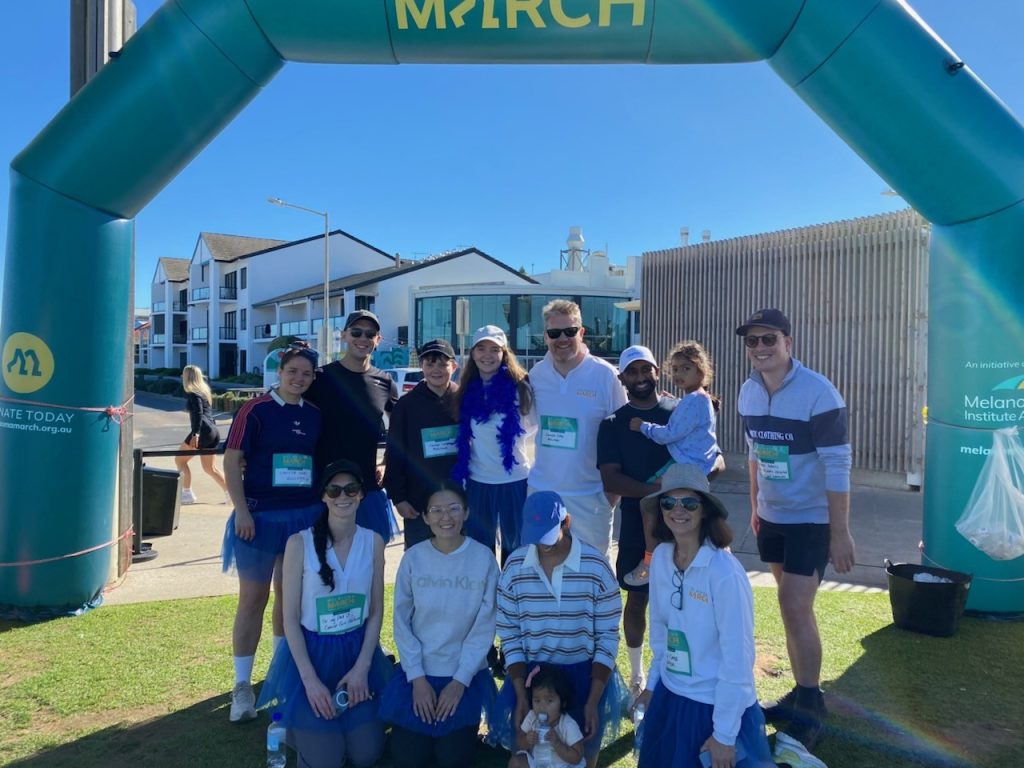
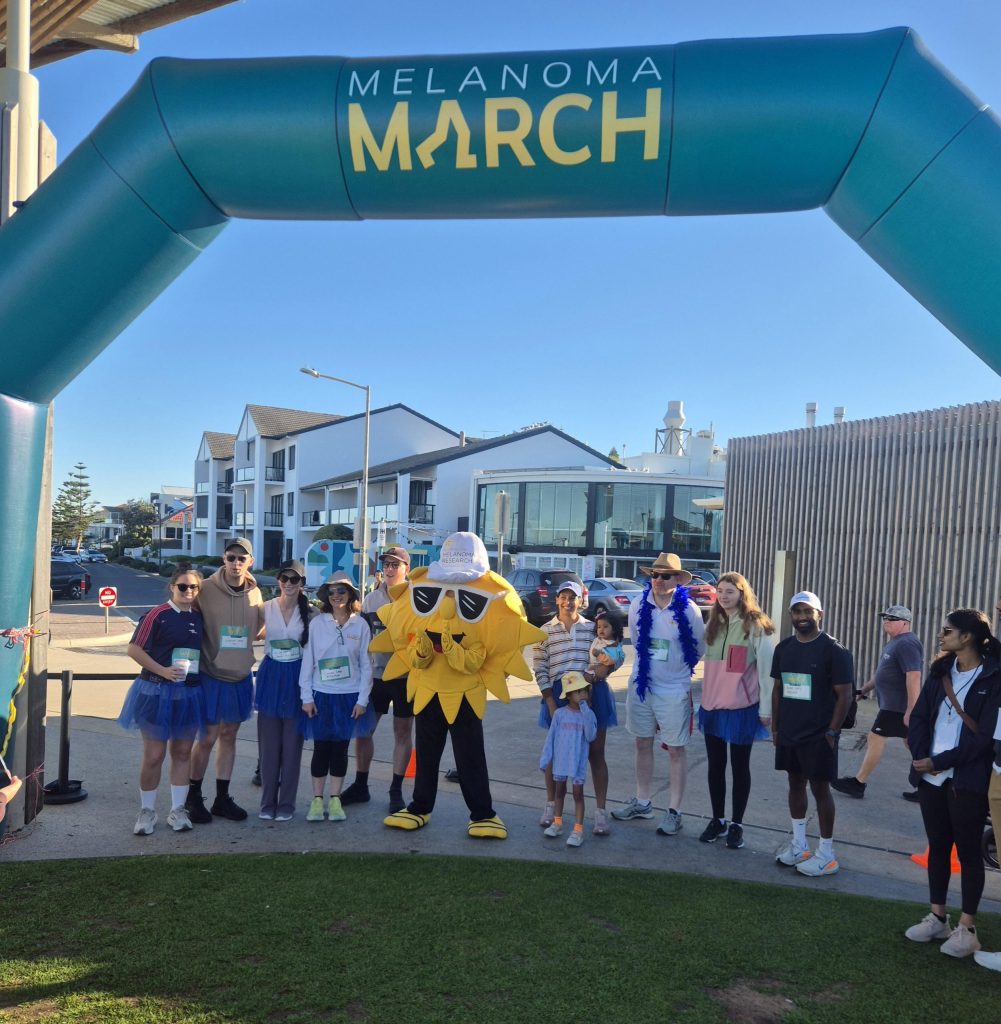
For medical oncologists, the impact of melanoma is not only measured in treatments and clinical outcomes, but in the lives of patients and families they walk alongside every day. In this interview, Adelaide-based oncologist Dr Rachel Roberts-Thomson reflects on joining the Adelaide Melanoma March for the very first time alongside colleagues, patients, friends, and family as part of Team Cancer Care Adelaide.
As a medical oncologist working closely with melanoma patients, what does participating in the Adelaide Melanoma March personally mean to you?
This was my first Adelaide Melanoma March although I have been aware of this important community event over the years. I was a little uncertain as to whether this was the right thing to participate in as a treating doctor but I am so glad that I did because the community coming together felt very powerful and positive and it was a very enjoyable day that felt like a lot of wonderful forward steps were being achieved.
“There needs to be continued momentum to look at why we are still losing people to this diagnosis and focus on innovative strategies and obtaining access to these.”
Your team “Cancer Care Adelaide” has been one of the leading fundraising teams in Adelaide. What inspired your team to get involved so passionately?
It really didn’t take much for the Team to agree to come together for the March. The Team on the day consisted of Clinical trial co-ordinators who support the work on Melanoma clinical trials, one of Adelaide’s wonderful Melanoma nurse specialists, a Medical Oncology colleague, a valuable administrative staff member, and our families.
Fundraising is important to be able to improve on outcomes in Australia with regards to all things melanoma whether it be prevention strategies, early detection and awareness strategies or treatment strategies. All of these important areas need funding and supporting.
From your perspective, how far has melanoma research and treatment come in recent years? What gives you hope for the future of melanoma care?
There has been progress over my career which has been immense. It has been exciting to witness the treatments improve and evolve. Nonetheless there needs to be continued momentum to look at why we are still losing people to this diagnosis and focus on innovative strategies and obtaining access to these. What gives me hope is knowing that there are very dedicated people in Australia working in laboratories and clinics and in advocacy roles towards a coveted zero deaths from Melanoma future.
“I believe that if we look out for each other by reminding regularly our friends, families and communities to wear sunscreen and drive sun-safe practices this is such a valuable step.”
How can everyday Australians help make a meaningful difference in the fight against melanoma?
I believe that if we look out for each other by reminding our friends, families and communities regularly to wear sunscreen and drive sun-safe practices this is such a valuable step. Putting up that sunshade and encouraging everyone to group under it may seem a small thing to do but does make a difference on that day and for those around you.
What is one thing you wish people knew about melanoma?
I would like people to know how common melanoma and other skin cancers actually are in Australia. Melanoma can take people by surprise and so good lifestyle practices over time will help protect you against this way too common and often preventable cancer.
Looking ahead, what are your hopes for the future of melanoma research in Australia?
For me this question is broad but I hope that we can identify why some people respond so well to the treatments we have and why others don’t and so we can hone in on features of this to be able to manipulate the tumour or host environment to improve on responses. I would also like to be able to better predict side effects that can occur to treatments and find ways of navigating this space with these predictors.
On the day itself, what was your favourite part of the Melanoma March experience?
I really enjoyed seeing how dedicated and committed those who attended were and how this event brought people together; people with their own personal experience, family members and those of their treating and supporting communities. It really was a lovely morning with great energy and togetherness.
“Fundraising is important to be able to improve on outcomes in Australia with regards to all things melanoma whether it be prevention strategies, early detection and awareness strategies or treatment strategies.”
Australian Melanoma Research Foundation (AMRF) respects and is committed to protecting the privacy of the people whose personal information it collects. We collect personal information about individuals who are employed by us, our donors, our volunteers, other supporters, allied associations, consultants and service providers.
Whenever we collect personal information, we will identify ourselves as AMRF and ensure people are aware of why we are collecting information and how we plan to use it.
The type of personal information AMRF usually collects and holds includes names, addresses, telephone numbers, email addresses, donation date, reason for donation, merchandise orders and other information such as health related information pertaining to AMRF research and program delivery. This information may be collected in person, via our website on the secure payment gateway, as well as other sources.
When people visit our website, or download information from it, the following information is recorded by Google Analytics:
This information is only used for statistical and website development purposes. We make limited use of cookies on our website. We use cookies to improve the functionality of our website, and to remember user preferences when people return.
In the event where an individual shares unsolicited personal information that AMRF would not have collected for the purposes outlined above that information will be destroyed or de-identified as soon as is practicable.
We collect and use stakeholder’s personal information to carry out the functions and activities of AMRF and to comply with our legal obligations, to maintain and update our records and to help us manage and provide our services.
We may also use information to ask for support and to keep people informed about the ways in which our donors and supporters help us to make a difference to raise funds for research, awareness and early detection programs. People have the right to opt out of any communications from AMRF. This will not stop them receiving receipts and other transactional communications as required by law.
We may disclose personal information to third parties who assist us to perform functions on our behalf (such as commercial mail preparation services, this information is permanently deleted by the provider upon completion of the service and confirmed in writing of such). These external service providers are under a duty to maintain the privacy and security of your information in line with this Privacy Policy and to use your personal information only for the purpose for which it is disclosed.
AMRF does not use any government related identifiers, such as Medicare numbers or tax file numbers, of an individual as our own identifier.
We may use people’s information within AMRF only in connection with marketing and fundraising campaigns. We may provide marketing communications to stakeholders on an ongoing basis by telephone, electronic messages (eg. email), online (including websites and mobile apps) and other means, unless they opt out or we are subject to legal restrictions. These may include communications relating to AMRF and our programs, campaign and promotional messages, event invitations, fundraising opportunities and newsletters.
AMRF also sends transactional communications which include but are not limited to: Donation & Tax Receipts, forgotten password e-mails, event sign up confirmation and confirmations from Web forms.
To opt-out of receiving AMRF marketing communications people can:
AMRF regards the security of personal information as a priority and takes a number of precautions to protect people’s personal information from loss, misuse, unauthorised access, modification or disclosure. Specific security precautions are in place for processing online payments through payment gateway providers Stripe and PayPal which include the use of encrypted links, dedicated private connections and Secure Sockets Layer (SSL) encryption. However, the Internet is not a secure environment and although all care is taken, we cannot guarantee the security of information people provide to us via electronic means such as email.
If people become aware of any inaccuracy in the personal information, we hold about themselves, they are encouraged to contact AMRF so we can update any personal information we hold.
Where it is lawful and practicable, we will allow individuals to deal with us on an anonymous basis. For example, if we receive a telephone enquiry, we will not require that the enquirer gives us their name, although depending on the nature of the enquiry, we may not be able to answer it unless they do.
We can also accept gifts and other forms of support anonymously. However, provisions contained in taxation legislation require AMRF to collect the name of the donor if the donor requires a tax-deductible receipt.
AMRF’s reputation and goodwill is extremely important. Permission to use images featured on this website has only been given to AMRF and therefore should not be downloaded or used in any way by a third party without consent.
For information on obtaining permission for an image, please email admin@melanomaresearch.com.au.
If AMRF updates or changes this Privacy Policy, the changes will be made on this page. Your continued use of AMRF’s website following the posting of changes will mean you accept those changes.
If you have any questions about privacy-related issues OR you wish to lodge a complaint about a breach of this policy OR other privacy matter OR you do not wish to be contacted by us to ask for your support, please contact us by email at admin@melanomaresearch.com.au. Alternatively our postal address is below:
AMRF
PO Box 574
Kent Town DC SA 5071
We take your privacy concerns seriously. Where you express any concerns that we have interfered with your privacy, we will respond to let you know who will be handling your matter and when you can expect a further response. We may request additional details from you regarding your concerns and may need to engage or consult with other parties in order to investigate and deal with your issue. We will keep records of your request and any resolution.
For information about privacy generally, or if your concerns are not resolved to your satisfaction, you may contact the Office of the Australian Information Commissioner at www.oaic.gov.au and on 1300 363 992.